

 Deutsch
 Español
 Français
 Italiano
 Português (Brasil)
 Português (Portugal)
Course in experimental astrology following the method of Lisa Morpurgo
Teaching notes for the lessons, compiled by Vezia Rode
Exaltations
with a short preamble on:
The four elements – the zodiacal Crosses
This is usually the subject with which ordinary astrology courses begin: the stress falls on the 4 elements present in the Zodiac and on their distribution, 3 signs for each element (4 x 3 = 12). I do not think that anyone who subscribes to L'Eco dei Feaci needs to be taught anything quite so elementary… I mention it only because, in the method of studying astrology devised by Lisa Morpurgo, “before” going on to the lesson on the exaltations she urged us to teach our pupils the “aspects” of trine and sextile, which depend precisely on the element of the signs between which they fall (judged harmonious because they involve the same elements — Fire, Earth, Air, Water — for the trines, and complementary elements, Air-Fire or Earth-Water, for the sextiles). It follows that the “squares” arising from belonging to the three “crosses”, cardinal, fixed or mutable, are judged “inharmonious” precisely because they set contrasting elements against each other, since each arm of the “cross” is formed by a sign of a different element. For the record, let us recall them:
Cardinal (they open a “season”): Aries, Cancer, Libra, Capricorn,
Fixed (they stand in the full of the “season”): Taurus, Leo, Scorpio, Aquarius,
Mutable (at the end of the season, when the weather is most changeable): Gemini, Virgo, Sagittarius, Pisces.
(Personally I consider oppositions less “difficult”, precisely because they usually involve signs of complementary elements.) The “aspects” that the planets form with one another are reckoned in degrees, according to the following division of the circle (Lisa accepted only these aspects, which come from dividing the circle by 12 and by its divisors); anyone who wishes is free to consider quincunxes or sesquiquadrates… but that is not our case:
360°: 360° = 1° (conjunction) valid up to 10° of orb
360° : 12 = 30° (semi-sextile) valid up to 2° of orb (28°-32°)
360° : 6 = 60° (sextile) valid up to 5° of orb (55°-65°)
360° : 4 = 90° (square) valid up to 7° of orb (83°-97°)
360° : 3 = 120° (trine) valid up to 8° of orb (112°-128°)
360° : 2 = 180° (opposition) valid up to 10° of orb (170°-190°)
A diagram summing up all the possible combinations can help in memorising the signs and the aspects that join them.
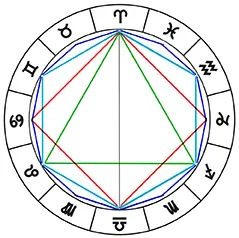
Exaltations
(that is, let us play… billiards, and learn more easily the “FUNDAMENTAL” lesson of Lisa's astrology)
| Exaltations ... a game of billiards |
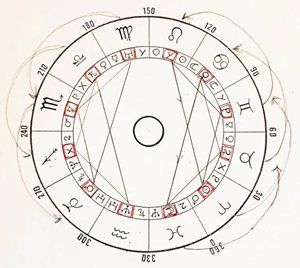 |
| Figure 3 |
All the “forces” examined in the first two lessons, which we have seen bound to summer or spring seasonal cycles and represented in an ideal cycle, shift continually and give us every variety of human character. So far we have spoken of “parallel” planets and of “opposite” planets and of their two domiciles. The considerations on analogous and opposite but complementary functions already give us a basis to reason from, but we still have to learn other privileged planetary positions: the exaltations.
To follow better “how” the Morpurgo method regards the exaltations — some of them differ from those held to be “traditional” — let us remember that the distances between planets considered positive or harmonious are the “trine” and the “sextile”, of 120° and 60° respectively, which are the result of the circle divided by 3 and by 6 (the figure obtained within the circle is in fact a triangle or a hexagon), and that a side of this triangle or hexagon joining two planets is called precisely a “trine” or a “sextile”.
All the aspects that bring two or more planets into relation cause an exchange of energies, without giving any absolute value to the words “positive” or “negative”, because everything is relative; and a careful examination of a birth chart can sometimes bring a surprise, when a “square” usually held to be “negative” turns out to be the strong point of a person spurred to concentrate his energies in that particular field and to make it a “winning” one… Just as the fine trine, considered a positive help, may do no more than… leave the individual content with what he has, and leave him there, quiet and inert.
Let us keep these premises in mind and now go on to see how the exaltations are formed, that is, where the planets find very favourable ground for showing their best qualities.
Let us remember that the discovery of the planets beyond Saturn, which upset the “magic” number 7, caused a great deal of confusion in the astrological field for a number of years. With Uranus, Neptune and Pluto the count reached 10; but since Pluto, from the moment it was discovered, has not yet made one complete “round” of the Zodiac, there are astrologers who do not even take it into account!
We know instead that it works (asteroid indeed!) and that it worked a great deal in the past too… and that there “ought” to be — announced and denied over recent years even by illustrious astronomers — at least two trans-Plutonian planets, for now “unknown” and therefore given no name but X and Y, which Lisa placed in their ideal position. In this way the “puzzle” comes to be completed with all its symbols; and if we follow Lisa's reasoning step by step, we shall discover a game as entertaining as a match of billiards…
Let us imagine once more the zodiacal circle divided into two exact halves between Leo and Cancer and between Capricorn and Aquarius (that is, between the extremes and the counter-extremes, the “adjacent” parallels). We shall then have the Sun (Leo) and the Moon (Cancer) at the top, and at the bottom Saturn and Uranus opposing them both from Capricorn and Aquarius. They form the two poles of extreme heat and extreme cold. Between these two extremes we find the temperate zone, just as between the two Poles, North and South, and the Equator lies the temperate zone of the two terrestrial hemispheres, where life is more bearable. Any change in the climate, even of very few degrees, but such as to melt the polar ice caps or to cool the planet, would overturn the world's balance (how prophetic Lisa was!). Now, in order to reach the extreme of heat there must be a beginning of warmth (spring), just as to the extreme of cold there corresponds a beginning of coolness (autumn): these are the laws of exaltation, which show with the utmost clarity why summer hooks on to spring and winter to autumn. We already know the primary and secondary domiciles of all the planets (with the exception of the Sun and the Moon, which have a single domicile). The fact that there exists another position in which the planets are said to be “exalted” has no plausible explanation in the sacred texts; the exaltations handed down to us are rather arbitrary, chosen, it seems, at the “pleasure” of individual astrologers rather than by following any logical reasoning — to say nothing of the most recently discovered planets, which are held to be “exalted” in the most various signs according to the liking or dislike they arouse in whoever examined them. Here one cannot even appeal to a “tradition”, given that Pluto was discovered only a few decades ago…
Through the exaltations the Zodiac reveals itself as a perfectly contrived instrument, which also indicates the movements of the planets — movements that have nothing to do with astronomical ones, but answer to quite particular geometrical and mathematical laws. Let us take up an imaginary cue and start from the Sun which, according to tradition, confirmed in this case, is exalted in the sign of Aries. We make it set off from Leo and travel a course of 120° (a trine) to arrive in the middle of Aries, beside Mars and Pluto, Lords of the sign, where it completes the “masculine” triad par excellence. It will therefore give due prominence to the sign with which the astronomical and astrological year begins, at the stroke of the spring equinox…
I am the first: that is the motto of Aries, and with this triad of “champions” there is no wonder! If we remember that Mars is the planet in “primary” domicile in the first decan of Aries and that Pluto occupies the last, its “secondary” domicile, then the bursting arrival of the Sun produces an “effect” that forces Pluto to shift by 60° and to arrive in Gemini, where it settles triumphantly in the middle, between Mercury (first decan) and Y (last decan). The attentive reader will not miss the fact that Pluto brings into the sign of Gemini that touch of theatrical “mask” which makes Gemini irresistible in the art of communication and of storytelling… the taste for imitation, for play, for intrigue, the skill of persuading people to buy things they have absolutely no need of…
And again by the “cushion” effect, it will be Y (the planet in secondary domicile) that in its turn receives a push of another sixty degrees, which will bring it to settle in the sign of… Leo, where in the Sun it will find its most powerful ally, one able to appreciate the lord of origins, of long spans of time, the Master of Time — where, in the Sun's own kingdom, the Sun itself will never set… the day ought to last for ever, eternity there to be won (Leo never turns the lights off). And we have ideally “closed” a triangle: Leo, Aries, Gemini, Leo (Fire, Fire, Air, Fire), finding the Sun exalted in Aries, Pluto exalted in Gemini, Y in Leo.
Let us take up the imaginary cue again and turn to the other Luminary, the Moon, starting it of course from the sign of Cancer. The reasoning is identical to the one made for the Sun, so with the first “shot” the Moon settles splendidly in the sign 120° away, that is Pisces, where it stands beside Neptune, lord of the sea in primary domicile, and Jupiter in secondary domicile. So far no scientist has been able to doubt that the Moon influences high and low tide; but, who knows why, none has reflected as well that our body is made up in the highest proportion of water, or that the female flow is also called the “monthly rule” and follows the lunar cycle… (Pisces is the most mystical and dreaming sign.) Of the two planets in domicile it will be Jupiter that takes the recoil from the Moon's arrival in exaltation, and it will shift by sixty degrees to leap into Taurus, where it will settle (happily) between X and Venus, making the sign by its presence still more sensual and pleasure-loving and inclined to the accumulation of material goods… A typical profession of the sign is that of the restaurateur, but also the herbalist, the perfumer, the ear-nose-and-throat specialist, the optician… And which planet will receive the impulse to… move on? Venus, naturally; and so with a leap of another sixty degrees it will go from Taurus to Cancer, closing the second triangle. What better ally for the Moon than Venus, who as lady of love and sweetness will be the ideal collaborator in making this the most feminine sign of the Zodiac — bound as it also is to the “Mother”?
The elements “touched” are: WATER, WATER, EARTH, WATER. And we have found the exaltations of the Moon in Pisces, Jupiter in Taurus and Venus in Cancer. Let us now pass to the “opposite” pole. We have seen that the “immovable” planets are those in “primary” domicile, while the “travelling” ones are in “secondary” domicile. If we remember that Saturn is the Lord par excellence of Capricorn while Uranus is of Aquarius (although both of them rule these two signs), it will be easy to understand in which direction they will move and which of them will do so. To find the exaltation of Saturn in Libra (tradition is confirmed in this case too) we must make it “set off” from its “secondary” domicile in Aquarius, travel the canonical distance of 120° and arrive in Libra. Libra is the sign of the autumn equinox: justice awaits its stern regulator, Saturn, which here stands beside two feminine planets, Venus in primary domicile and X in secondary (love cannot leave law aside, and law makes the marriage bond “legal”). It will obviously be X that “rebounds” sixty degrees and is exalted in Sagittarius, beside Jupiter (primary) and Neptune (secondary): the symbolic womb of the Earth that has received the seed and begins its transformation. From here it will naturally be Neptune that “shifts” sixty degrees, to be exalted in Aquarius beside Uranus and Saturn, giving this sign the stamp of genius and of unruliness, the intuition of the scientist, the inventor, the creator, the musical innovator. A triangle closes: AIR, AIR, FIRE, AIR. And we have the exaltations of Saturn in Libra, of X in Sagittarius and of Neptune in Aquarius.
From Capricorn (by now the game is almost done) we make Uranus “set off”: a good leap of 120° and… there, it lands in Virgo, between Y and Mercury, and will make the sign the most technically perfect and precise of them all, where “hands” and machines will find their best employment. In this seat Y is primary and Mercury secondary, and it will indeed be the latter that rebounds into Scorpio, with a leap of sixty degrees, between Pluto and Mars, where it will give the sign its very fine intellectual sharpness, its ferocious wit, its strategist's cunning. Here the one who “commands” is Pluto, and Mars is subordinate… so it is easy to see that it will be Mars that shifts sixty degrees and is exalted in Capricorn: beside Saturn and Uranus, Mars will make people strong and unshakeable as boulders, implacable with their enemies, ambitious and tenacious, without weaknesses or fears: the best surgeons. And at last the final triangle closes: EARTH, EARTH, WATER, EARTH.
So we have found the exaltations of Uranus in Virgo, Mercury in Scorpio and Mars in Capricorn. This is how the Exaltations of the twelve planets are found, according to Lisa. Would you like to make the “test” of the opposite? (The astrological equivalent, as it were, of casting out nines…) Take a ruler and you will easily see how all the planets have a natural “opposite”, which will always be in opposition, from whatever part of the Zodiac one starts. It is the exaltations that tell us which, between Saturn and Uranus, is the “true” opposite of the Sun (they are exalted in Aries and in Libra): it is Saturn — cold set against heat, as reason is set against the heart, against solar warmth and vitality. Uranus-Virgo, on the other hand, is the natural opposite of the Moon-Pisces: the pragmatism of today, technique, set against the memory of the past, against vagueness and longing, against the emotions. The other natural “opposite” planets are:
The opposite of Mercury is Jupiter (adolescents set against adults, hearing against speech, pupils against teachers: they are opposite and complementary, and neither can subsist without the other…), from every domicile and from the exaltation. Still more evident are the natural opposites Venus and Mars (they are the mythological lovers par excellence, and prove that opposites attract each other irresistibly). X and Pluto: the Feminine Principle and the Masculine Principle — the same holds as for Venus and Mars, always the attraction between the sexes, the foundation of human reproduction; in Pluto there is the seed which must take form in the womb of X. Y and Neptune: the conservation of time and the metamorphoses of the living, a continual struggle. Periods of “conservatism” and periods of “renewal and metamorphosis” will always alternate.
We should also learn that, besides the DOMICILE and the EXALTATION, which are the positions in which the planets show their virtues to the full, the “opposite” positions of the same planets are called DETRIMENT and FALL: that is, when a planet that rules a zodiacal sign by domicile comes to be in the opposite sign it is said to be in “detriment”, and if the sign is opposite to its exaltation it is said to be in “fall” — evidently because opposites are less “hospitable”… If we follow the Sun, we shall see that it is in Detriment in Aquarius (the cold winter does not let it express its warmth) and in Fall in Libra, when the downward curve begins from the autumn equinox to the winter solstice… And so the Moon will be in detriment in Capricorn and in Fall in Virgo, the opposites of Cancer and Pisces. Here is a table to help remember:
| Planet | Signs of domicile | Signs of detriment | Exaltation | Fall |
|---|---|---|---|---|
| Sun | Leo | Aquarius | Aries | Libra |
| Moon | Cancer | Capricorn | Pisces | Virgo |
| Mercury | Gemini – Virgo | Sagittarius – Pisces | Scorpio | Taurus |
| Venus | Libra – Taurus | Aries – Scorpio | Cancer | Capricorn |
| Mars | Aries – Scorpio | Libra – Taurus | Capricorn | Cancer |
| Jupiter | Sagittarius – Pisces | Gemini – Virgo | Taurus | Scorpio |
| Saturn | Capricorn – Aquarius | Cancer – Leo | Libra | Aries |
| Uranus | Aquarius – Capricorn | Leo – Cancer | Virgo | Pisces |
| Neptune | Pisces – Sagittarius | Virgo – Gemini | Aquarius | Leo |
| Pluto | Scorpio – Aries | Taurus – Libra | Gemini | Sagittarius |
| X | Taurus – Libra | Scorpio – Aries | Sagittarius | Gemini |
| Y | Virgo – Gemini | Pisces – Sagittarius | Leo | Aquarius |
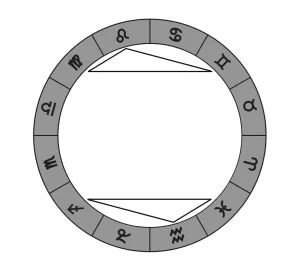
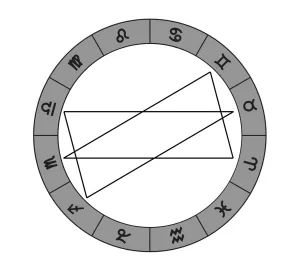
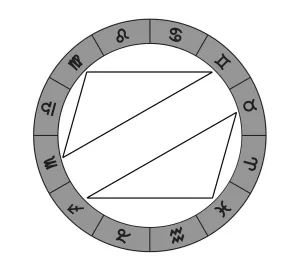
Other diagrams show how the “triangulations” of the opposites work, joining the three positions of each planet, in particular for the “parallel” planets. The positions of the opposites that take in the Sun and the Moon are clearly “short” of one point, but they show interesting figures, worth reflecting on:
 |  |  |
By kind permission of astrologiamorpurghiana.it