

 Deutsch
 Español
 Français
 Italiano
 Português (Brasil)
 Português (Portugal)
Course in experimental astrology following the method of Lisa Morpurgo
Teaching notes for the lessons, compiled by Vezia Rode
Domiciles
Let us look once more at the circle with its division into parallels, and note that the planets occupy, two by two, the same portion of the zodiacal circle, in parallel. The credit goes to Barbault for having grasped that the succession of the planets to the right of the Sun and to the left of the Moon, which ended with Saturn, had to be carried on in both directions with the discovery of the new planets. From this comes Lisa Morpurgo's supposition that there must be two more planets beyond Pluto, which for the moment we call X and Y — and we know that some Russian and American scientists have already put forward the idea that they exist. We have seen how the Sun and the Moon are the origin of life and the two pivots of the personality. The whole sequence of planets from the 1st to the 12th that we have already seen, from Y through to Mercury, arranges itself on the other side of the circle as well. Only the Sun and the Moon remain alone, to symbolise generation. It is not that the Sun and the Moon are the “parents” of the planets: this is a symbolism bound up with life. Life that expresses itself in a “circular” way, and that is bound to parallels and to opposites. For now we are dealing with the parallels; later we shall look at the “opposites”. This law of circularity, if one wishes to penetrate the true nature of the zodiacal symbols, tells us that we must avoid taking a single element on its own, detached from the rest: each one lives because it has an analogue and an opposite. When this chain is doubled, the circle appears like this:
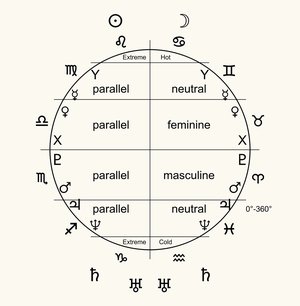 |
| Figure 2 - The Doubling |
So we see that in both circular halves of the Zodiac, which represents the unity of the human person, in a sign to the east and in a sign to the west there are the two analogous functions we already saw last time: quick time and slow time, the female and male sexual symbols, and so on. The sequence of the signs will be explained through the arrangement of the planets. The sequence of the signs runs from right to left and is motionless, fixed. The planets, on the other hand, are a mobile series, not only because they really do move — it is this that brings about the succession of events — but mobile through their symbolism too. These shifts create combinations of the greatest interest for interpretation. Let us see how the planets arrange themselves on this fixed lattice, a kind of grid, a cathedral rose window across which the colourings of the planets pass.
Let us say at once that the Sun and the Moon are the planets that rule Leo and Cancer, which correspond to the two hottest summer months, the months in which the life of the season reaches its peak: life as symbolic expression is the highest expression of heat, it is heat. If we examine their position, in two different signs even though adjacent ones, we see the first differences between the Sun and the Moon — differences that stand out in this exact seasonal position. The Moon in Cancer takes on the characteristics of a period in which the wheat is about to be reaped and the fruit about to be gathered: nature, then, at the peak of its productivity, the symbol of the mother who has given birth. There is that character of the woman newly delivered, which belongs to Cancer. The Moon — mother — who as a new mother has exhausted her function and at the same time holds within her a fullness, the satisfaction of having brought forth the fruits, with all the trepidation the new mother puts into fearing for her baby, and the care she takes of herself, the attention not to eat anything that might spoil the milk, and so on. Leo is the period in which the fruits of the earth are gathered in, and the Sun in this sign expresses all its radiant happiness, the joy of the harvest, the euphoria, the optimism, the generosity, the warmth, and also that touch of exaggeration, of swagger, of waste which answers to all those threshing dances one sees in paintings, the gold of ripe wheat gathered into sheaves. The harvest, good or less good, is always a feast. To the warmth of the Sun, as we know, one drinks a toast, one dances, one plunges into a bath of light and often lets oneself go to the joy of living without worrying about tomorrow. In this parallel of the “adjacent extremes” there is a symbolism of patriarchy: there is a mother who produces and a father who administers, a possessor or a squanderer.
Let us pass to the next parallel, to the double belonging of Mercury and Y in Gemini and in Virgo. From what can we deduce the differences between the two signs? From these too: from the particular time of year in which they are placed. Let us think of the symbolism of Y as slow time and Mercury as quick time. In Gemini, where the season is pressing on from spring towards summer, there is the anxiety to ripen quickly; nature has a more intense wish to live because it is approaching the peak of life (at the end of Gemini and the beginning of Cancer comes the summer solstice). Mercury in Gemini tends to accelerate time, like the adolescent who wants to grow up quickly, to become an adult, even though he does not yet quite know what he wants to do when he is grown, and today thinks of being an astronaut and tomorrow a DJ. Mercury, quick time, is readiness to pick things up, to catch the news, quickness of hearing, love of novelty, a taste for imitation. It is the individual with his eye fixed on what is new, on reform, on change. In Virgo we find the last month of summer, and the approach of autumn slows the rhythm down: the days grow shorter, the heat is less intense, nature expresses itself more slowly and calmly because it no longer holds all those fermenting saps that must make ready for the harvest; here slow time, Y, will prevail. In Virgo we can deduce the presence of Y not only from this slowing of time, but from the need of a month which already feels the first cold in the air and in the bones to become cautious and, out of the necessity taught by age-old or personal experience, to become conservative. And so that harvest which lay on Leo's threshing floor and which Leo himself was squandering like a merry grasshopper, Virgo, like a wise ant, will try to put aside for harder times. There is this tendency to stop time, to preserve everything that can be preserved in order to survive the winter (here we find all the preserved goods: jams, tomato sauces, frozen food, and all the technical devices for freeze-drying, drying, smoking, salting, freezing and so on). Common to both signs will be curiosity, intellectual liveliness, attentiveness, care for detail. Let us remember that Gemini's wish to invest itself with various characters, to put on a mask, is very Plutonian, just as Virgo's manual skill is very Uranian.
As we approach the parallels that house the sexual planets, we must consider both of them, because the difference consists mainly in the fact that Mars and Pluto in Aries come before Venus and X in Taurus, whereas Mars and Pluto in Scorpio come after Venus and X in Libra. Let us always remember that the male and female reproductive organs are bound to these planets.
The presence of Venus and X in the sign of Taurus is symbolically bound to the fertilised Earth, in whose womb the crops are sprouting and coming to birth, since in the preceding sign, Aries — which represents the beginning of spring with the awakening of nature after the winter sleep — it is in a certain sense the fertilisation of nature that took place; and so the Taurus woman has known her wedding with Mars and Pluto and flowers luxuriantly. The hormonal ferment that accompanies gestation makes the woman serene: she appreciates a good table, genuine food rich in vitamins, she shuns artificial things, she has a great taste for living well in order to carry towards life the creature she bears in her womb; there is besides the wish to offer that creature security, and hence the desire to possess material goods, so characteristic of Taurus. Just as animals make their nest more comfortable before laying their eggs in it, so the house will be welcoming and beautiful. Great importance is then given to scents — not for nothing is May the month of roses, and the birds are singing… In the sign of Taurus we find the eyes, the nose, the mouth (sight, smell, taste), and because of its pleasure-loving, possessive nature the characteristics of X will prevail. In the sign of Libra, on the other hand, Venus prevails. Venus in Libra represents the woman who awaits her bridegroom, who prepares for the wedding, the chosen one of the Jewish people, since in the preceding sign, Virgo, she has recovered her virginity, as the earth has made itself ready for the new sowing and the furrow has been closed again after the crops were gathered. It is not, then, femininity lived through marriage; she does not have the cast of mind of the Taurus woman who thinks of her child and her family: she is the woman who must choose, with the utmost selective rigour, the seed that will fertilise her. Hence the hesitation before choices, the doubt, the judgement. On that seed will depend the future harvest, the begetting of the child. Here we find the rigour and the formality that Taurus does not have. In nature the trees begin to lose their leaves, nature still provides tasty fruit (grapes, chestnuts), and the colours of autumn are perhaps the most beautiful nature can produce… Venus is the queen of beauty and of art, and so in Libra we shall find the love of justice and of law (it is the scales of Libra that stand in every courtroom). Just as in Libra we shall find legal unions, marriage, associations.
The difference between Mars and Pluto in Aries and in Scorpio is even more evident when we consider the season. With Aries begins the great festival of spring, with all the ferment that seizes plants and animals, which obey an instinct of reproduction that will determine their matings and will make them do even the strangest things, incomprehensible to the human mind (think of the salmon that swim miles upriver to lay their eggs… or the fights between stags to secure command of the females). To break the bark of the tree or the hard clods of the earth, the buds must call upon Martian strength and energy: so in Aries it is Mars that prevails. In Scorpio, instead, there is the night life of the seed, which begins with the farmer ploughing the land in November and casting the seed into it; and it is Scorpio that, by swallowing the seed and letting it rot underground — symbolically buried, dead — will then make it rise again in spring, after a long night journey through the coldest months. Hence that “occult” character, bound to death, in which Scorpio has always been wrapped, often with gross exaggeration. It is a vital discernment far more careful than the one Aries puts to work. Nature itself, in November, loses all its leaves, and the trees, stripped to skeletons, look dead as well.
Let us pass to the parallel that houses Jupiter and Neptune, which corresponds to Sagittarius and Pisces. If we take up again the symbolism of the wedding, we remember that fertilisation took place in the preceding sign, Scorpio. (There are two kinds of “gestation” interwoven in the Zodiac: the more visible one, which might be compared to the carrying of pollen from flower to flower, in spring; and the “secret”, nocturnal one, followed by the long winter stillness. This period may be compared to growth in the mother's womb — from Scorpio to Pisces — whereas from Aries to Cancer it is the young creature itself that reproduces.) It is right, then, that Neptune and Jupiter should accompany the metamorphosis of the cell and its growth. Jupiter prevails in Sagittarius, where the growth and development of the embryo is likewise enormous in the first months, while in the last months, even if more visible, it is proportionally smaller. The need to be protected by fortune is greater at the beginning; once the first months have passed, the risks of miscarriage diminish too. Physically Sagittarius is often tall, slender, jovial, a big eater (and grows heavier with the years…). In Pisces the child is already formed, and the second symbolism of Neptune comes into play: adaptation to the surroundings. It seems that in the last months of pregnancy the child already perceives what is happening outside; it can hear sounds and noises (if they are too loud it is frightened) while it lets itself be rocked by the amniotic fluid. It is precisely here, and in this period, that there forms that longing for the foetal time which can accompany the neuroses of some adults who never resign themselves to the trauma of coming into the world and to giving up that comfortable, dreaming life. Neptune's perceptions are often extrasensory, due perhaps to those months in which the outside world was only sensed and guessed at, and in which a certain unconscious fear of having to face it took shape: hence the wish to flee from reality that belongs to Neptune.
Here are the last adjacent parallels (the counter-extremes), which house Saturn and Uranus, the highest point of cold. It is the narrowing of the circle: let us not forget that in this symbolism of the circle, Saturn and Uranus are the first and the only ones we find “opposed” to the Sun and the Moon — the other narrow point of our circle, which widened at the centre, where it houses reproduction, and has come down again towards this point that stands against life, just as in summer life is at its peak and in winter seems to halt in a frozen stillness (some animals hibernate, waiting for spring). Winter represents the non-life of the season, nature turned to stone, unmoving. Capricorn and Aquarius both house Saturn and Uranus. Saturn is also the symbol of old age, as though it felt this chill in the bones, with the slowing of the vital faculties and of the metabolism, the weakening of the muscle's spring; old age is greatly feared by those who love the warmth of life. But we must not see in these signs the end of life, nor the disaster and the malefic power that traditional astrology attributed to Saturn. Saturn and Uranus represent the awareness of an end that we all carry within us; and clearly, with this awareness of the end, there are certain traits of behaviour dictated precisely by it — an awareness that may be fearful or serene, and that is a most important factor in one's behaviour towards life, towards others, towards oneself. At the very moment when they represent this apparent end of life (for the Zodiac tells us that life is unbroken, and rebirth comes with every spring), the tree that has lost its leaves puts them out again, and man perpetuates himself in his children. By the mere fact of being circular, the Zodiac shows us that the end joins on to the beginning again. So Saturn and Uranus symbolise both the awareness of the end and the means by which that end can be neutralised, or at least put off as long as possible: with reason, with reflection, with common sense, and also delayed by the discoveries, inventions and technical devices given by Uranus, while Saturn will dictate reason. In Capricorn the measures for protecting nature will be put into action — even the seed knows it must not come out into the frost and die. The discovery of fire, to heat the house and cook food. In Aquarius there is an important fact, well known to farmers. The seed sown in November begins to germinate in Sagittarius until mid-December, then stops for 40 days (that is, throughout Capricorn) and takes up its germination again in the first days of February, in Aquarius, where life is still hidden in the seed; but with this renewed germination there is less pessimism, a greater lightness within rationality, a greater practical sense in orienting the roots in the soil and choosing the most suitable place to come out into the open. Here more than anywhere else one can see the difference made by the element:
Earth for Capricorn, Air for Aquarius. (The division of the circle into 12 signs belonging to the four elements, three for each element, is important for the next lesson.)
| FIRE | EARTH | AIR | WATER |
|---|---|---|---|
| Aries | Taurus | Gemini | Cancer |
| Leo | Virgo | Libra | Scorpio |
| Sagittarius | Capricorn | Aquarius | Pisces |
By kind permission of astrologiamorpurghiana.it