

 Deutsch
 Español
 Français
 Italiano
 Português (Brasil)
 Português (Portugal)
Course in experimental astrology following the method of Lisa Morpurgo
Teaching notes for the lessons, compiled by Vezia Rode
Introduction
The Zodiac is a perfect instrument, one we are only beginning to study experimentally and do not yet fully know. We must set aside prejudice and preconception. Let us try to understand the logical reasons and the origins of this instrument, and “why” it works. Because, starting from empirical observation, astrology gives us a percentage of correct answers far higher than the pure law of coincidence can tolerate. With this astrological method we shall find laws that are logical and acceptable even to those who reject any magical or esoteric explanation — and therefore, in a future we hope is near, acceptable to science as well. Let us consider, to begin with, a double sequence of 12 elements: 12 planets and 12 signs. As a basis we start from something as simple as a circle, around which we arrange the numbers in sequence from 1 to 12. We then divide this circle into twelve sectors and draw parallels across it, on which an even number and an odd one will naturally come to sit side by side, and where 12 naturally stands next to 1.
1 Sun
2 Y
3 X
4 Pluto
5 Neptune
6 Uranus
7 Saturn
8 Jupiter
9 Mars
10 Venus
11 Mercury
12 Moon
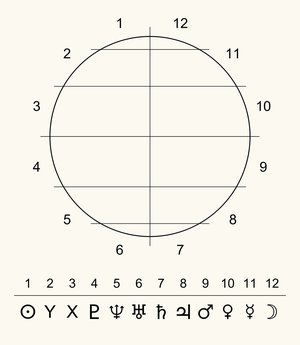 |
| Figure 1 - The Circle |
The circle is one of the oldest symbolic figures, and its meaning is very clear: it represents the flow of time and of life. 1 and 12 represent the beginning and the end of life, since anything we call “alive” is so only because at a certain point it dies, that is, it ends. There would be no beginning without an end. This circularity stands for life flowing through time. So we find the flow of time and of events, from 1 to 12, just as the reading of past, present and future events is the basis of astrological analysis. Let us now examine the parallels, on which we have arranged the planets in pairs that perform analogous functions.
The first is a parallel we shall call “extreme”, taking in 1 and 12: it represents a whole which symbolically is the complete human being — man as man and woman as woman, that is, the active part and the passive, receptive part of the human being. The planets here are the Sun and the Moon, always paired with the masculine and the feminine as with the two aspects of personality and character: the father and the mother, or the “parents” of the Zodiac, since within it they perform a patriarchal function, analogous and complementary.
The Sun is the core of the personality, the synthesis of the Self; it gives us the measure of the solar and passionate virtues: warmth, courage, loyalty, generosity. Carried to excess, these qualities become pride, arrogance, overbearingness, dictatorship. Anatomically the Sun corresponds to the heart, the solar plexus, the arteries, the right-hand side of the body.
The Moon represents the sensitivity of the Self and the emotional contacts with the surrounding world. It is closely bound up with the mother's womb and with the female vital functions; it can give weak or submissive attitudes, a search for support, candour, infantilism. Carried to excess, these become hypersensitivity, impressionability, restlessness, anguish. It represents woman (mother, wife, lover, daughter for a man), while for a woman it is — besides the mother — her way of living her own femininity, and her relationships with other women as well. The Moon governs sleep and dreams, and rules fresh water and milk. Physiologically the Moon corresponds to the breast, the stomach, the left-hand side of the body. It can bring about illnesses affecting these organs, or the lymphatic and digestive systems.
We have seen how, in this parallel, the Father-Mother or Man-Woman functions are analogous in themselves, and how in a certain sense they stand apart from the other parallels that follow, as a single whole. This scheme maps out everything that can concern an individual life, but it also maps out a cosmic scheme of universal life. For us the planets are 12, because there really are two further trans-Plutonian planets, already spoken of in recent years but not yet officially named: we call them X and Y.
We find Y at once in the parallel that follows, side by side with Mercury. This parallel performs a function that is analogous and the same for everyone, men and women alike, and is therefore called “neutral”. (2-11)
Y = it is the farthest planet, the first ring of the spiral of concentric orbits that narrow around the Sun; it is the lord of origins, of time, of the hardening of the Earth's crust, of the forming of the continents and the oceans; it is the divine wind of the atmosphere, the primordial element of life. It is the lord of the time that began to mark out the indispensable rhythm of light and darkness, of warm and cold seasons. Its discovery will allow meteorological and geological phenomena to be interpreted and foreseen. It is the lord of long spans of time.
Mercury = it is the nearest planet and, like Y, it is bound up with time, but it concerns the quick, rapid rhythm (let us remember the winged Mercury of mythology). It corresponds to the first contact of the Self with the outside world, to the beginning of a cerebral life. Mercury governs intelligence, the ability to take in messages and reproduce them, to understand. It governs intellectual exchange, of ideas and of opinions, and the technical instruments suited to that purpose (printing, telephone, radio). It is the typical representative of adolescence, with quick mental reflexes and with natural liveliness and restlessness. In a birth chart it represents brothers and sisters, children, contemporaries, playmates, fellow students and workmates, and also fellow countrymen, close relatives, neighbours. It joins with Y in governing the first “vital” and independent activity of the human being as soon as the umbilical cord is cut: “breathing”. In the human body, in fact, the bronchi belong to Mercury and the lungs to Y — those bellows that fill and empty automatically, without our noticing; and yet if they did not, life would be gone in a few minutes. A person can go without eating and drinking for quite long stretches, but cannot live without breathing for more than a few minutes. To Mercury, moreover, correspond the arms, the wrists, the ear, the nervous system. To Y belongs the ability to fall in with the rhythm of life, with the surrounding atmosphere, to have or not to have a sense of time, to love clocks or not.
Now the circle widens, and the pairs of sexual planets appear: in parallel 3-10 we find the “feminine” planets, while in parallel 4-9 we find the masculine ones.
Here is X = the great feminine principle. In mythology it might be Cybele, Demeter, Persephone, the Great Mother Goddess, the immense womb of living nature. From the cosmological point of view it corresponds to the appearance of plant life on our planet, and it is therefore linked to forests and wood as well. It is the fertilised earth putting forth shoots. Its discovery may help to clear up certain genetic mysteries. In the female human body it corresponds to the uterus, while in men and women alike it governs the hair follicles. It gives a sense of possessive, enveloping femininity, the most authentic female sexuality — far more attributable to X than to Venus.
Venus represents affectionate contact with the outside world; it indicates the capacity to love, to enjoy beauty and the good things of life; it gives the aesthetic sense, an intense desire for peace, harmony, serenity, comfort. The appreciation of life's simple joys. It marks the passage from Mercury's adolescent curiosity to social relationship, to the desire to love and to be loved. It assists artistic creation, above all manual creation (craft work), and confers manual skill. Well placed in a chart it is a help from fortune, and indicates good health too. In the human body it governs the metabolism and the functions of the kidneys.
Pluto, or the great masculine principle. Pluto represents the seed that fertilises, and therefore reproduction and the instinct that guides it. Pluto is the receptacle of the seed (so in the male human body it represents the testicles) and, in general, it gives the measure of the reserve of creative possibilities and of the capacity for practical achievement, deep and hidden in each of us. The capacity to surpass oneself in life's great trials, to recharge one's vital energies over and over. It is the lord of satisfaction or dissatisfaction with oneself, which lies at the root of individual balance. In a negative position it gives a sterile proliferation of the ego, a search for affirmation as an end in itself, failing which the individual may become a mythomaniac or a frustrated person. It has, however, no bestial or animal character, despite its connections with sex. It can bring about deviations and aberrations arising from frustrations due to incapacity or impairment. From the cosmological point of view it corresponds to the appearance of animal life on our planet.
Mars, on the same parallel, represents aggressive contact with the outside world; it gives the measure of strength, the capacity to fight for survival, the violence needed to overcome obstacles without regard for doubt or hesitation. In the male human body it corresponds to the virile member, in its two aspects of erection and subsidence. In terms of character too, Mars is credited with bursts of impulsiveness, enthusiasms followed by discouragement and depression. As in life, there can be sudden successes and sudden collapses. Complexes of impotence to be overcome. It can be responsible for a lack of tact and of reflection; it gives impetuousness, a choleric temperament. The primordial man who survived was the one who was naturally the most aggressive, who overcame enemies and rivals, who killed the wild beasts. A negative Mars indicates the possibility of accidents, fractures, torn muscles. In the human body generally it governs muscle tone and activity, and sporting competitiveness. As a personification, in a woman's chart it can also indicate the man she loves, or the zodiacal type of man she feels most drawn to.
After the bands of sexual parallel planets, we find another band of parallel planets called “neutral”. (5-8)
Let us start from Neptune, called the planet of metamorphoses. Not for nothing is it bound to the sea, to the amniotic fluid, where from the beginning of cell division the human embryo will go through every possible metamorphosis in order to become human. In the chronological symbolism of the Earth it corresponds to the diversification of the animal species and to their metamorphoses, necessary in order to survive (fish that grew wings and learned to breathe out of the water, reptiles that put out legs in order to walk…). The memory and the longing for foetal life that accompanies us in the unconscious means that Neptune is often flanked by dreams, by the wish to escape from reality (including refuge in drugs, or more simply in alcohol); it gives a most lively curiosity for the remotest and most sublime things, and for very long journeys in exotic countries as well. It can be the planet of madness and of genius, with the desperate will to deny one's own identity in order to take on another. It gives creativity at the very highest level, musical genius (its transit through the signs of this parallel, Sagittarius and Pisces, has in fact always accompanied the birth of very great musicians, and has also favoured the birth of precociously gifted musical children), and intuitions of a mediumistic kind. On this parallel it is flanked by Jupiter, which helps it towards an optimistic footing in life, to feel anguish less, to see that genius meets with material success too, with financial good fortune and recognition. Moreover, while the child grows in the mother's womb it is Jupiter that allows growth and expansion.
To Jupiter belong the functions of the pineal gland and probably of the thyroid. To Jupiter, again, belongs speech, oratory, the ability to convince with a smile, optimism, good humour (this is why one says: he is a jovial sort…). To Jupiter as mouth corresponds the joy of living and therefore of eating well; growth can also bring an unwanted gain in weight, from too much food. If Jupiter is over-stimulated we shall get precisely the eloquent pontificators and the unrestrainable big eaters. Jupiter's optimism is necessary, for otherwise man would never have taken a step to go and see what lay beyond, and fear of the unknown could have held him back. Jupiter widens horizons and wants to go ever further. Individual happiness and serenity depend largely on it. It gives a love of philosophy. Jupiter also corresponds to the legs (all of them: ankles, knees and thighs, while Neptune, its partner, rules the feet), which allow us to move and therefore to set off on long journeys.
Now the circle narrows and, for the first time, we find two parallels that “oppose” the first ones we have already seen. Saturn and Uranus oppose the Sun and the Moon, as cold opposes heat and Reason opposes the Heart. After the expansive, optimistic force of Jupiter we find the restrictive, pessimistic force of Saturn. Trustfulness goes together with distrust, both of them indispensable to safeguard life. But before Saturn, let us begin by examining Uranus, which comes closer to us after Neptune.
Uranus is the first of the planets called slow that can complete the whole round of the Zodiac within a human lifetime (the times of Neptune — 165 years — and those of Pluto, 250 years, are beyond our reach; who knows what those of X and Y may be!) But Uranus can come back upon itself and give a splendid last stretch of life to a few privileged old people… Picasso, Pertini… Cosmologically, the appearance of man on our planet is attributed to Uranus. To Uranus, moreover, correspond anatomically the hands, and everything man has created with his hands, as well as the technology that creates machines able to replace the hands entirely, from the first typewriter to the modern computer. It is a very dynamic planet: it can use any fulcrum to destroy or to create, according to circumstances. Domiciled in the heart of winter, like Saturn, Uranus is the force of immediate decision, and often has a drastic character. It is quickness of mental reflexes; it is centred on today, it does not look to the past and does not care about the consequences for the future. It is Saturn's great ally, because where Saturn is the stripping away of the superfluous, Uranus is the elimination of the useless; and where reason weighs up all the negative circumstances in order to organise the defences better, it falls to Uranus to decide quickly which method to adopt and, if need be, to cut clean through without regret or second thoughts. Uranus is the “light bulb” that goes on in the scientist's mind and makes him understand how the atom works — and does not make him think of the consequences his intuitions may have for humankind.
Saturn, planet of reason, has always been paired with old age, with distrust, with prudence, with detachment from the passions, with stoicism, with the strength of mind to overcome adversity. Hardness (stone), duration — the human skeleton, the teeth, the hardest parts of our body, the bones. For a great many years Saturn represented the end of life, the closing; but it is not at all true that where Saturn passes only misfortunes happen: one of its transits can in fact be very positive. Reason is the knowledge of good and evil, the forbidden fruit that won man conquests denied to other living beings, but tore him from the earthly paradise of eternal happiness. Here is Melancholy, bound to Saturn: the price to be paid for original sin, the desire for Knowledge.
By kind permission of astrologiamorpurghiana.it